


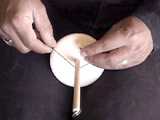
Tying on the Leader
To begin spinning on a bottom whorl drop spindle, attach a leader to your spindle by tying a piece of yarn about 18 inches long onto the shaft right above the whorl, then take the yarn over the side of the whorl, loop it around the shaft underneath, and back over the side of the whorl, and secure the end onto the hook.
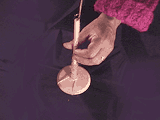
Spinning
Leave the fibers at the end of the leader loose. Let the spindle hang beneath your hand suspended by the leader. Take the spindle in your right hand and the leader in your left hand, spin the drop spindle from the shaft in a clockwise direction. This is the direction you will be spinning to make the yarn. Allow yourself time to practice making the spindle rotate. Repeat this process of spinning the spindle in the same direction until the leader begins to take in the twist. Leave a fluff of fiber at the end for joining on more fiber.
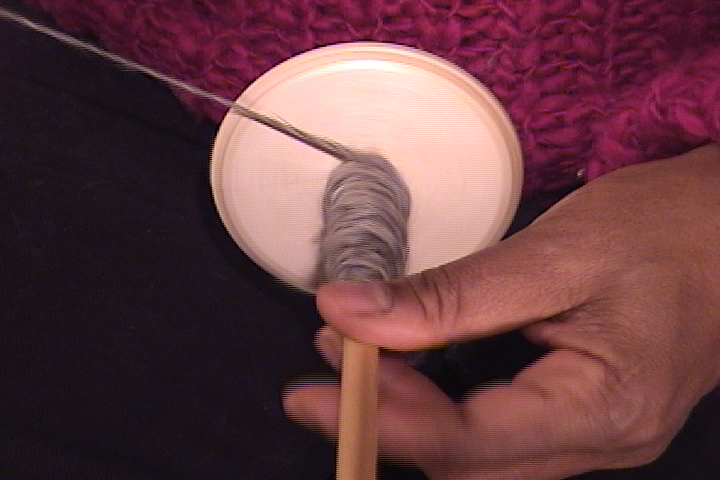
Winding On
Always keep tension on your newly spun yarn to allow the twist to run into the newly drafted fiber, if you release the tension, the twist will not travel up. Repeat this process a couple of times and check to see that there is enough twist before moving on. If the yarn pulls apart or the yarn is too slack spin the spindle again to store more twist. When the yarn is long enough to cause the spindle to almost touch the ground, unhook the yarn and wrap it around the base of the spindle next to the whorl. You have just spun what is called a single. Leave enough yarn unwound in order to slip it back on the hook with a couple of extra inches to spare-loosen the end fibers.
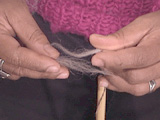
Joining More Fiber
To add on the more wool, overlap the wool a few inches over the fluff of drafted fibers to catch and twist into the leader. Let the twist run into the joined fibers, add more twist by spinning the spindle before you continue making a new length of yarn, otherwise your join may not be secure. (It is important not to try and make a join of new fluff fibers over an already spun section of yarn.) It is good practice to test the join before continuing. Give the spindle another twist, and bring your right hand back to where the left hand is holding the yarn. Move the left hand back about three inches, pulling and drafting out more fibers of wool and letting the spindle turn around a few times. Let go of the yarn with your right hand and let the twist move up into the fibers like before. Gently pull out more fibers from the fiber mass by pulling back with your left hand, allowing the twist to run into the drafted fibers.
Troubleshooting
If your yarn pulls apart, you need to add more twist. To connect the ends back together, untwist both ends again and loosen the fibers. Lay one side on top of the other and twist the fibers together like before.
If the spindle gets away from you and the twist runs up into the fiber mass, which is a common occurrence for beginners,, stop the spindle and untwist the fiber mass—then start the drafting process again.
If the yarn is over twisted, loosen some of the extra twist by drafting out more fibers.
If there are “fat soft areas”, known as slubs in your yarn or thick spots and thin spots, you can keep them and make a novelty yarn. You can remove them by pinching the yarn with both hands on either side of the slub (a little back from the slub) and untwisting it until the fibers draft out a little.
After you have wound off a considerable amount of singles the spindle will become to heavy and will start to wobble a lot as you are spinning it. When this happens it is time to stop spinning yarn and remove it from the spindle.